Strengthening ICC workflows
Reliable ICC data depend on well-defined marker expression, high-quality antibodies, and well-established immunocytochemistry protocols. ioCells offer a highly characterised, predictable starting point—supported by expert ICC guidance and validated antibody recommendations—helping make ICC workflows more robust and reducing unnecessary repeat optimisation.

Consistent cells
Reduce repeat ICC by working with human cells that show reproducible protein expression, meaning canonical marker characterisation is needed only once.

Optimised protocols
Access optimised ICC protocols that support diverse immunocytochemistry applications and help improve experiment efficiency and timelines.

Antibody recommendations
Use our verified antibody recommendations for key markers to ensure reliable immunocytochemistry staining.
ioCells in action
ioCells in action
Clear immunocytochemistry staining across motor neuron markers
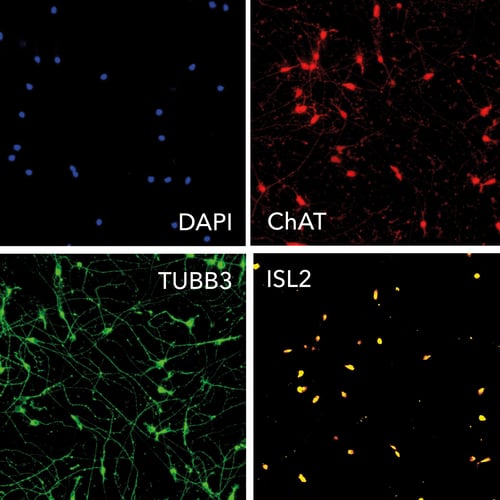
Fig 1. Immunocytochemistry characterisation of ioMotor Neurons. Representative ICC images show nuclear staining with DAPI (top left) and expression of canonical motor neuron markers ChAT (top right), TUBB3 (bottom left), and ISL2 (bottom right). Images demonstrate clear marker localisation and single-cell resolution suitable for phenotypic analysis and imaging-based readouts.
Defined ioMotor Neurons provide a reliable starting point for immunocytochemistry applications by enabling clear marker detection and single-cell resolution imaging. Their consistent identity and morphology support efficient ICC workflows, helping reduce variability and improve phenotypic interpretation.
Protein-level changes in DMD disease models
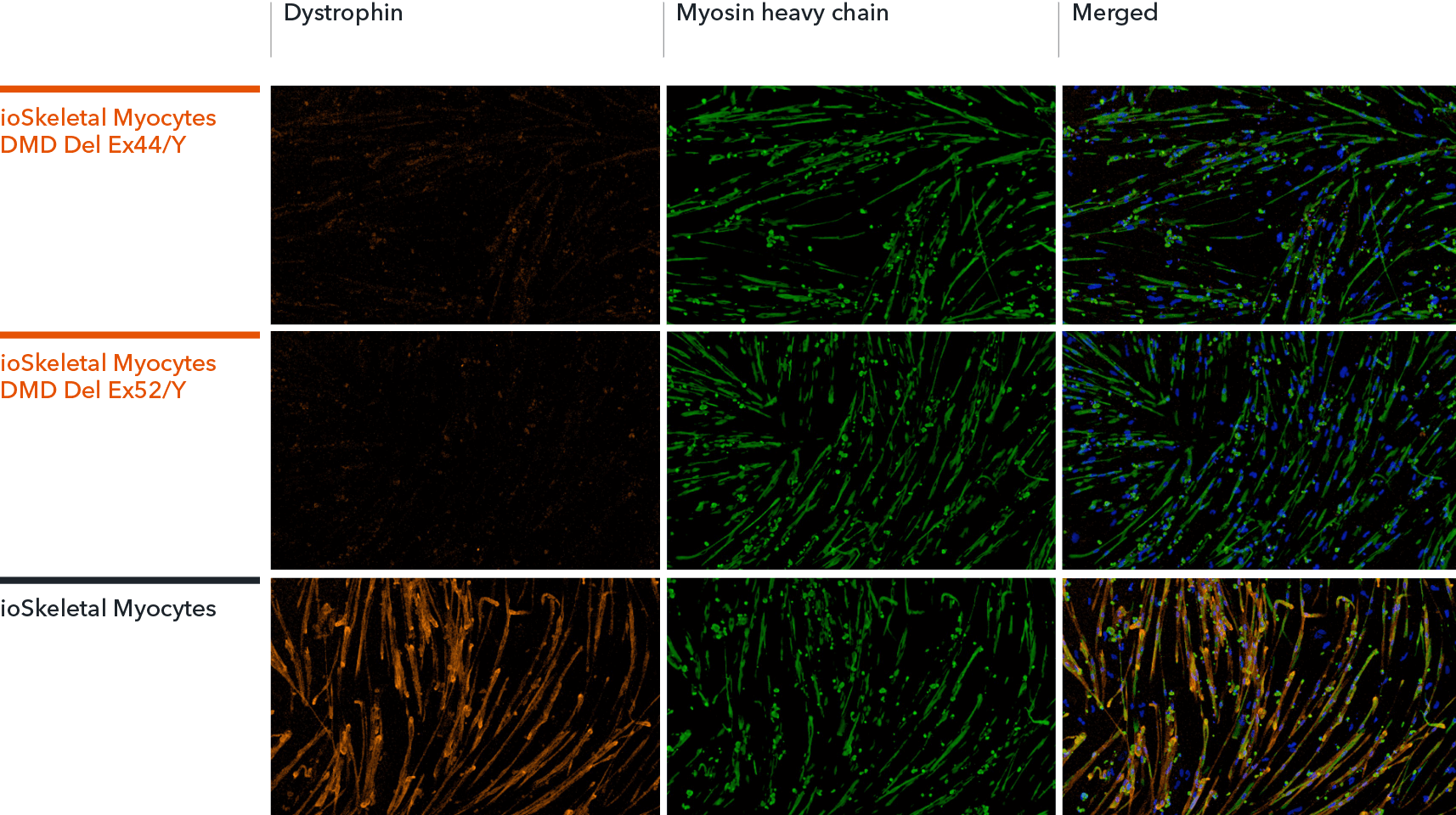
Fig 2. Immunocytochemistry detection of dystrophin localisation in ioSkeletal Myocytes. Representative ICC images show dystrophin (left column), myosin heavy chain (middle column), and merged channels (right column) across ioSkeletal Myocytes carrying DMD exon 44 or exon 52 deletions (top and middle rows) compared with wild-type cells (bottom row). Data courtesy of Charles River Laboratories.
Immunocytochemistry supports the detection of disease-associated protein localisation changes in human muscle models. In ioSkeletal Myocytes, ICC enables comparison of control and disease states at single-cell resolution, supporting phenotypic analysis and disease modelling workflows.
Oligodendrocyte marker expression in quad cultures
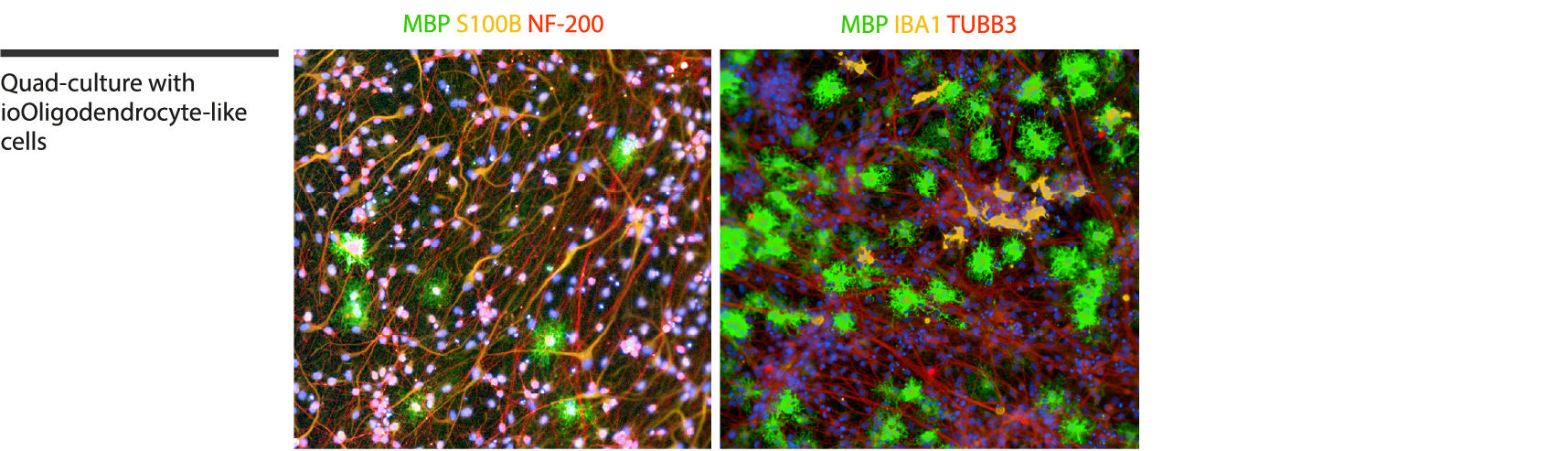
Fig 3. Immunocytochemistry visualisation in a quad culture model. Representative immunofluorescent staining, analysed on day 14, shows MBP-positive ioOligodendrocyte-like cells (green) co-cultured with ioGlutamatergic Neurons expressing NF-200 (red) and TUBB3 (red), ioMicroglia expressing IBA1 (yellow), and human iPSC-derived astrocytes expressing S100B (yellow). DAPI counterstain appears in blue.
Immunocytochemistry reveals distinct populations of neuronal and glial cells within complex quad-cultures. For ioOligodendrocyte-like cells, ICC enables the assessment of maturation markers, such as MBP, supporting studies investigating glial contributions to neurodegenerative disease pathology.
db-cAMP drives oligodendrocyte maturation
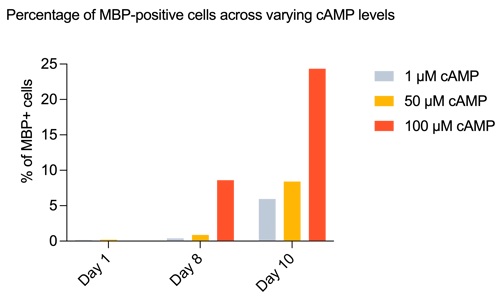
Fig 4. Quantification of MBP expression in ioOligodendrocyte-like cells following db-cAMP treatment. Quantitative analysis shows an increase in the proportion of MBP-positive cells with increasing db-cAMP treatment across culture time points, supporting assessment of oligodendrocyte-like cells maturation through immunocytochemistry-based readouts.
Immunocytochemistry enables quantitative evaluation of treatment-driven protein expression changes in human glial models. In ioOligodendrocyte-like cells, ICC supports assessment of MBP expression as a marker of maturation, informing studies of differentiation and myelination-related biology.
Recommended resources
Ready to browse?
Explore our full portfolio of human iPSC-derived ioCells, suitable for use in immunocytochemistry applications, flow cytometry, functional assays, and more, to achieve reproducible, high-quality results every time.discovery.