19.12.2025 | Published by bit.bio
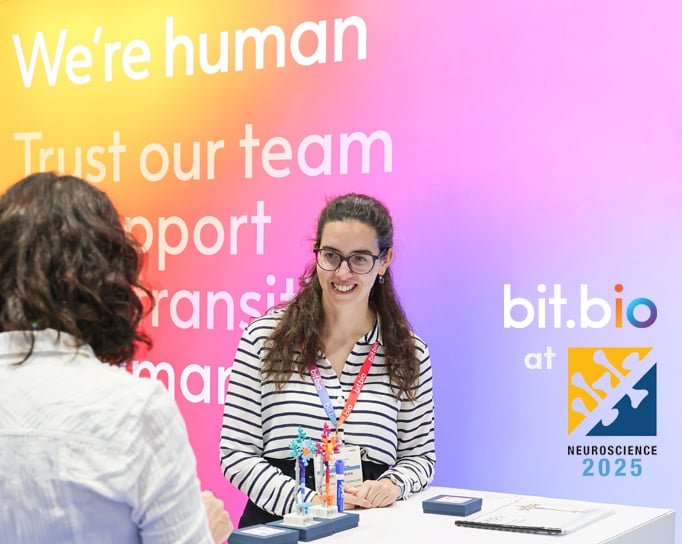
The momentum at this year's Society for Neuroscience meeting was unmistakable. Across posters, talks, and discussions, the narrative around human in vitro models has shifted. The focus is no longer on on whether and how we can generate functional human cells from iPSCs, but on how to build models that are mechanistically informative, multicellular, and predictive. Researchers are moving beyond simple monocultures toward integrated systems that capture circuit-level behaviour and cell–cell interactions. SfN 2025 made it clear: the field is now thinking in terms of function, complexity, and translational relevance.
Multi-regional brain models are becoming the new standard
One of the clearest signs of this shift is the rise of multi-regional brain models, or assembloids. By combining distinct organoids (cortical, thalamic, hippocampal) researchers can study how brain regions connect and communicate, giving access to circuitry that drives human behaviour.
Assembloids vs standard organoids: What is the difference?
Standard organoids | Region-specific identity; limited connectivity
Assembloids | Inter-regional communication, functional circuity, network phenotypes
Assembloids provide access to the circuit-level mechanisms that underlie many neurodevelopmental and neuropsychiatric disorders
A standout example came from Rebeca Blanch (Muotri Lab, University of California San Diego), who compared cortico-thalamic assembloids with standard organoids in modelling CDKL5 Deficiency Disorder. The fused models captured the E/I imbalance and maturation defects associated with epilepsy in a functionally integrated, circuit-level model.
This is a significant step forward for modelling neurodevelopmental disorders such as autism and schizophrenia, where pathology is rooted in connectivity rather than isolated cellular deficits.
Engineering meets biology: toward scalable, patient
While assembloids address anatomical complexity, engineering-led innovation is tackling scale and physiological relevance. A dominant theme was the patient-on-a-chip approach, integrating microfluidics, high-content imaging, and iPSC biology. These platforms enable high-throughput testing of compounds on cells carrying a patient’s genetic background, an operationalisation of personalised medicine.
Melissa Hernandez (Salk Institute) showcased a compelling transdifferentiation workflow that scales 2D neurons and astrocytes into 3D constructs while retaining the donor’s ageing signature, which is often erased during reprogramming.
Coupled with advanced MEA systems capturing real-time network dynamics, these models open the door to functional screening for disorders such as Alzheimer’s and ALS that demand network-level readouts.
If you are exploring functional activity in human neuronal systems, you can find MEA datasets and protocols on the bit.bio website.
Glia take centre stage in next-generation disease models
SfN 2025 made clear that advancing disease relevance requires moving beyond neurons alone The role of glia, astrocytes, microglia, and oligodendrocytes, was central across the conference.
Researchers presented increasingly complex co-culture and tri-culture systems to model:
- Microglial-driven neuroinflammation in Parkinson's disease
- Oligodendrocyte-mediated myelination deficits in multiple sclerosis
- Astrocyte-neuron interactions that drive neurodegeneration
These systems expose therapeutic targets that remain invisible in neuron-only cultures, underscoring the need for integrated human models.
To see how defined human iPSC-derived glial cells are used in co-culture and mechanistic studies, visit the glia product and application pages on the bit.bio site
“From the perspective of someone deeply involved in functional assay development, the challenge is no longer biological feasibility, but operationalisation. Moving from robust 2D systems to complex 3D models demands improvements in reproducibility, scale, and standardisation. Academic-industry collaboration will be key, especially for MEA interpretation and functional readouts”
 Luke FoulserField Applications Scientist
bit.bio
The direction is clear, and the field is accelerating
Despite the challenges, the trajectory is encouraging. Advances in cell programming, chip technologies, and AI-driven imaging are removing barriers that previously slowed adoption of complex human models.
SfN 2025 left one message resonating through the community; we are entering a phase where human in vitro models are no linger proofs of concept, they are becoming functional systems for discovery.
For practical resources, including culturing and assay protocols, tutorial videos and troubleshooting tips, you can access the bit.bio support hub.
FAQs
What were the major trends in human in vitro neuroscience models at SfN 2025?
The major trends in human in vitro neuroscience models at SfN 2025 centred in the shift toward integrated, mechanistically informative systems. Researchers moved beyond simple monocultures toward multi-regional brain models, patient-specific microengineered platforms, and glia-inclusice co-cultures that capture circuit-level behaviour and disease mechanisms more accurately than previous models
Why are assembloids important for disease modelling?
Assembloids are important for disease modelling because assembloids recreate inter-regional connectivity, allowing researchers to study disorders rooted in circuit dysfunction such as CDKL5 deficiency disorder, autism, schizophrenia. By fusing cortical, thalamic, or hippocampal organoids, assembloids provide access to network-level phenotypes that cannot be reproduced in isolated region-specific organoids.
How are MEA systems used in disease models?
MEA systems are used in disease models because MEA platforms quantify network activity, synchrony, and firing patterns, providing functional readouts that reflect circuit-level phenotypes. This makes MEA essential for studying diseases where network behaviour is a defining feature - including epilepsy, Alzheimer's disease, ALS, and other disorders where synaptic or circuit dysfunction emerges before molecular endpoints.